Real Estate Data Scraping: A Complete Practical Guide
A practical guide to real estate data scraping, from defining fields and sources to validation, organization, and ongoing data workflows.
_Mesa-de-trabajo-1.svg)
Real estate businesses work with large amounts of information across property listings, company websites, public business pages, market resources, and other online sources. When that information needs to be collected into a structured format, real estate data scraping can become part of a repeatable data workflow.
The challenge is not simply collecting information from web pages. A useful real estate dataset needs a clear purpose, defined fields, consistent formatting, duplicate control, validation, and a process for maintaining the data over time.
This guide explains a practical approach to real estate data scraping, including what to collect, how to structure the workflow, how to validate results, and when a dedicated extraction service can make sense.
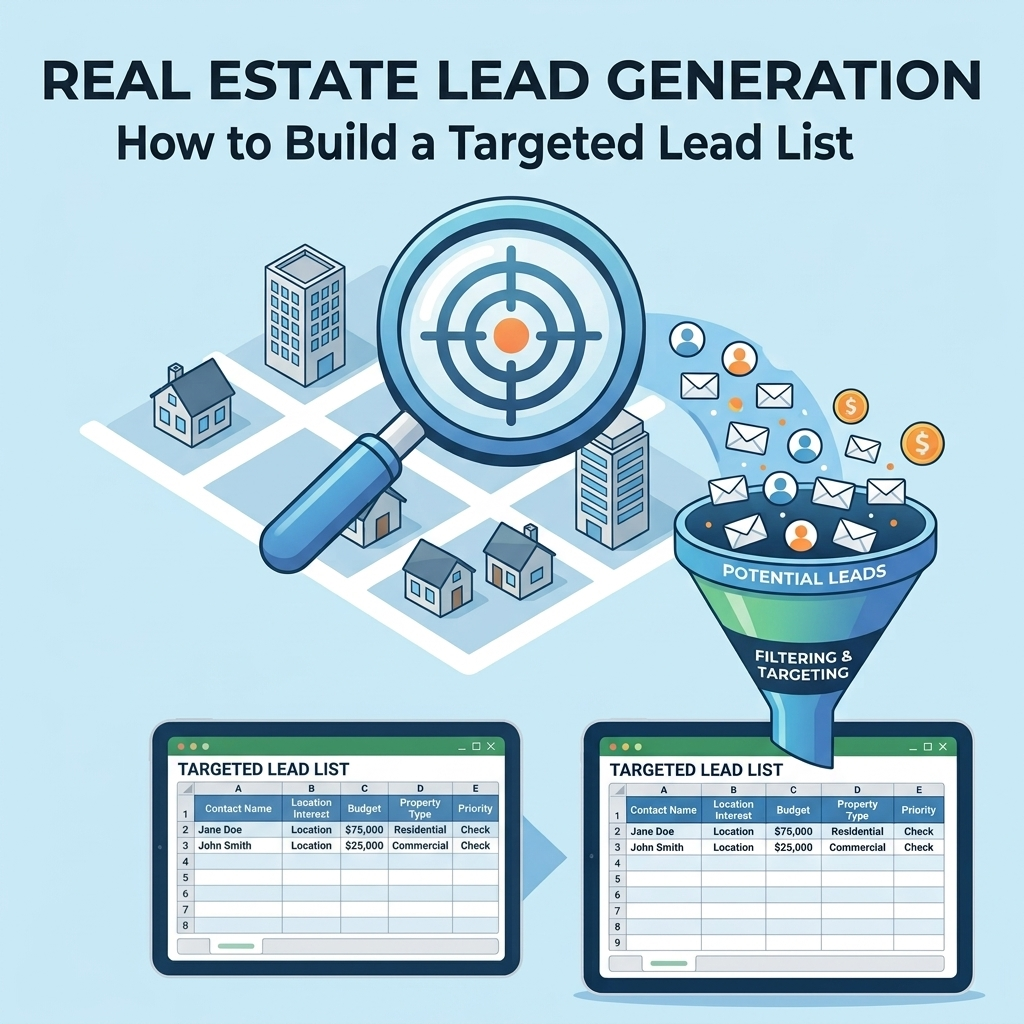
What Is Real Estate Data Scraping?
Real estate data scraping is the process of collecting relevant information from online sources and organizing that information into a structured dataset.
Depending on the business objective, the dataset might contain property information, business information, geographic details, listing attributes, contact-related fields, or other publicly available data relevant to the defined project.
The important distinction is between collecting web data and building usable business data. Scraping is only one part of the workflow. The final dataset should also be reviewed, standardized, validated, and prepared for its intended use.
Why Real Estate Businesses Use Scraped Data
Real estate organizations may need structured data for several different workflows. The exact fields and sources should depend on the business objective rather than collecting as much information as possible.
- Market research: Organize property or business information for research projects.
- Prospecting: Build structured records for sales and business development workflows.
- Property research: Collect selected property attributes into a consistent format.
- Geographic analysis: Organize records by location, market, neighborhood, or other defined geographic criteria.
- Competitive research: Structure relevant information about businesses or properties for internal analysis.
- Database development: Create a dataset that can later be imported into another business system.
The strongest scraping projects begin with a clearly defined question: What decision or workflow will this dataset support?
Start With the Data Requirements
Before collecting anything, define exactly what the final dataset should contain. This prevents unnecessary collection and makes quality control much easier.
Define the Target Records
First decide what represents one record in the dataset. Depending on the project, a record could represent a property, real estate business, professional, listing, location, or another defined entity.
Do not mix different record types without a clear structure. For example, property-level information and company-level information may need separate fields or related tables.
Define Required Fields
Create a field list before extraction begins. A practical field plan might look like this:
| Data Group | Example Fields | Purpose |
|---|---|---|
| Property | Property name, address, property type | Identify and describe the property |
| Location | City, state, ZIP code, market | Geographic organization |
| Business | Company name, website, business category | Identify the related organization |
| Listing | Listing-related fields required by the project | Support listing research |
| Source | Source page or source identifier | Maintain traceability |
The example above is a planning framework, not a universal real estate schema. The actual fields should be determined by the intended use of the data.
Choose the Right Data Sources
A scraping project is only as useful as the sources selected for it. Different sources can provide different types of information, so source selection should follow the field requirements.
For each source, document:
- What information the source is expected to provide
- Which fields should be collected
- How records will be identified
- How source information will be tracked
- How missing or inconsistent fields will be handled
Keeping source information in the dataset can also make later review and maintenance easier.
Build a Structured Extraction Workflow
A practical real estate data scraping workflow can be organized into several stages.
- Define the objective: Establish what the dataset needs to accomplish.
- Define the record: Decide what one row or record represents.
- Map the fields: Create the required and optional field list.
- Identify sources: Determine which sources contain the required information.
- Collect the data: Extract the selected fields into a structured format.
- Standardize records: Apply consistent formatting to names, locations, and other fields.
- Identify duplicates: Detect records that may represent the same entity.
- Validate the dataset: Review completeness, consistency, and obvious data-quality issues.
- Prepare the output: Format the final dataset for the intended workflow.
- Document the process: Record the source, field definitions, and relevant processing rules.
This separation is important because raw extraction and final data preparation are different tasks.
Real Estate Data Scraping vs. Manual Data Collection
Manual research can work for small, highly specific tasks. However, when the same fields must be collected repeatedly across many records or sources, a structured extraction workflow can make the process easier to manage.
| Consideration | Manual Collection | Structured Scraping Workflow |
|---|---|---|
| Record-by-record research | Common approach | Can be structured around defined fields |
| Field consistency | Depends heavily on the researcher | Can follow predefined field rules |
| Repeatable projects | May require repeated manual work | Can be designed as a repeatable workflow |
| Quality control | Often handled during manual review | Can include dedicated validation stages |
| Structured output | Requires manual organization | Can be planned around a defined schema |
The right approach depends on project size, complexity, source structure, required fields, and how frequently the data needs to be collected.
Standardize Real Estate Data After Extraction
Collected records often need normalization before they are ready for business use. Without standardization, similar records can appear different even when they refer to the same entity.
Company Names
Apply consistent rules for capitalization, spacing, abbreviations, and other formatting decisions that matter to the project.
Location Fields
Keep city, state, ZIP code, and other geographic fields in separate columns when the workflow requires geographic filtering or segmentation.
Categories
If property or business categories are being collected, establish a consistent category structure instead of allowing many variations for the same concept.
Missing Values
Do not treat missing information as if it were confirmed information. Use a consistent representation for missing fields so downstream users can distinguish incomplete records from populated records.
Duplicate Detection Is a Core Data-Quality Step
Duplicate records can appear when the same entity is found through multiple sources or when a source contains repeated information.
Before removing duplicates, define what qualifies as a duplicate for the project. Depending on the dataset, useful matching fields may include:
- Property address
- Company name
- Website
- Phone number
- Other project-specific identifiers
Some records may require manual review rather than automatic removal. A duplicate-control process should preserve the most useful information and avoid deleting records simply because two fields look similar.
Validate the Extracted Dataset
Validation should happen after extraction and standardization. The goal is to identify records that require correction, review, or exclusion before the dataset enters a business workflow.
Check Required Fields
Review whether required fields are populated. A record missing an essential identifier may need additional research or a separate review status.
Check Field Consistency
Look for inconsistent formats across the same column. For example, geographic fields should follow the same structure throughout the dataset.
Check Duplicate Records
Run duplicate checks using the matching rules defined for the project.
Check Source Traceability
Where appropriate, retain enough source information to make later review possible. This can help distinguish an extraction issue from a source-data issue.
For projects requiring structured quality control, BrainyFlavors provides Data Validation as a related service.
Organize the Final Dataset for Business Use
A clean dataset should be easy for the intended user or system to understand.
Before delivery or import, define:
- Column names
- Field definitions
- Required fields
- Data formats
- Duplicate-handling rules
- Missing-data conventions
- Source fields
- Segmentation fields
For teams that use spreadsheets as part of their workflow, Google Sheets Automation can also be relevant when extracted data needs to move through a structured spreadsheet-based process.
Design the Dataset Around the Business Question
One common mistake is collecting every available field simply because it can be collected. More data does not automatically create a more useful dataset.
Instead, work backward from the business question.
- What decision or workflow will use the data?
- What records are needed?
- Which fields are essential?
- Which fields are useful but optional?
- Which sources contain those fields?
- How will records be validated?
- How will duplicates be handled?
- How frequently will the dataset need to be refreshed?
This approach keeps the extraction project focused and makes the resulting dataset easier to maintain.
Common Real Estate Data Scraping Mistakes
- Starting without a field plan: The output becomes inconsistent or difficult to use.
- Collecting too many fields: Extra information increases processing and review requirements without necessarily improving the workflow.
- Ignoring duplicates: Repeated records can reduce the usefulness of downstream analysis and prospecting.
- Mixing record types: Property, company, and contact information can become difficult to manage when their relationships are not clearly defined.
- Skipping validation: Raw extracted data should not automatically be treated as ready-to-use business data.
- Ignoring missing values: Incomplete records should be identifiable rather than silently treated as complete.
- Failing to document the workflow: Without field definitions and processing rules, future maintenance becomes harder.
- Building a one-time process for recurring needs: If the same dataset will be collected repeatedly, the workflow should be designed with repeatability in mind.
When to Use a Real Estate Data Extraction Service
Internal teams may be able to handle small data projects. A dedicated extraction workflow can become more useful when the project requires multiple sources, many fields, repeated collection, structured output, or significant data preparation.
BrainyFlavors provides Data Scraping for businesses that need structured data extraction workflows.
Need Real Estate Data Extracted?
Define the real estate data you need, the target sources, and the required output format. Request a data extraction project tailored to your workflow.
Real Estate Data Scraping Checklist
Use this checklist before starting or reviewing a scraping project:
- Define the business objective.
- Define what one record represents.
- Create the required field list.
- Identify appropriate data sources.
- Define source-tracking requirements.
- Plan the extraction workflow.
- Standardize names, locations, and categories.
- Identify and review duplicate records.
- Validate required fields and formats.
- Separate complete and incomplete records.
- Prepare the final dataset for its intended system or workflow.
- Document field definitions and processing rules.
- Define how recurring updates will be handled.
Conclusion
Real estate data scraping is most useful when it is treated as a complete data workflow rather than a simple collection task. Defining the target records, selecting the right fields, organizing sources, standardizing results, controlling duplicates, and validating the final dataset all contribute to making extracted information more useful for real estate businesses.
For projects that require structured real estate data extraction, a clearly defined workflow can turn scattered online information into a dataset that is easier to review, analyze, and use in business processes.
Written by
Ashraful Haque
Process Improvement Consultant & Operations Specialist with expertise in Lean Six Sigma, financial workflows, and business intelligence systems.
Comments
Leave a comment
Comments are moderated and will appear after approval.
Recommended Products

Laplink PCmover Ultimate 11 - Migration of your Applications, Files and Settings from an Old PC to a New PC - Data Transfer Software - With Optional High Speed Ethernet Cable - 1 License
Migrate your applications, files, and settings from an old PC to a new one automatically - with optional high-speed Ethernet cable support.
Check Price
Process Improvement Specialist and Artificial Intelligence: A Practical Self-Learning Course for Mapping Work, Finding Waste, Using AI Responsibly, and Building an Improvement Portfolio
A practical self-learning course for process improvement specialists covering work mapping, waste reduction, responsible AI use, and improvement portfolios.
Check Price
FYI: For Your Improvement - Competencies Development Guide, 6th Edition
A practical development companion for identifying professional strengths, building competencies, and turning improvement areas into focused growth.
Check PriceRelated Articles
Digital Marketing Tools & Software: Best Practices
Learn how to evaluate digital marketing tools and software by workflow, data, automation, reporting, and integration needs.
Read Article →Technical SEO Tools: Software and Best Practices
Compare technical SEO tools by purpose, learn what each can diagnose, and build a practical workflow for auditing and monitoring your website.
Read Article →Technical SEO Strategies: Advanced Best Practices
Learn how to diagnose technical SEO issues, improve crawling and indexing, manage canonical URLs, and build a practical optimization workflow.
Read Article →