Lead Generation Best Practices: A Practical Guide
Learn practical lead generation best practices for finding relevant prospects, improving lead quality, and building a repeatable sales process.

Effective lead generation is not simply about finding more contacts. A strong process helps a business identify relevant prospects, organize useful information, qualify opportunities, and move sales activity through a repeatable workflow.
For B2B organizations, lead generation best practices provide a practical framework for improving how prospects are identified and managed. The right approach depends on the target market, sales process, available resources, and type of customer, but several principles apply across many business models.
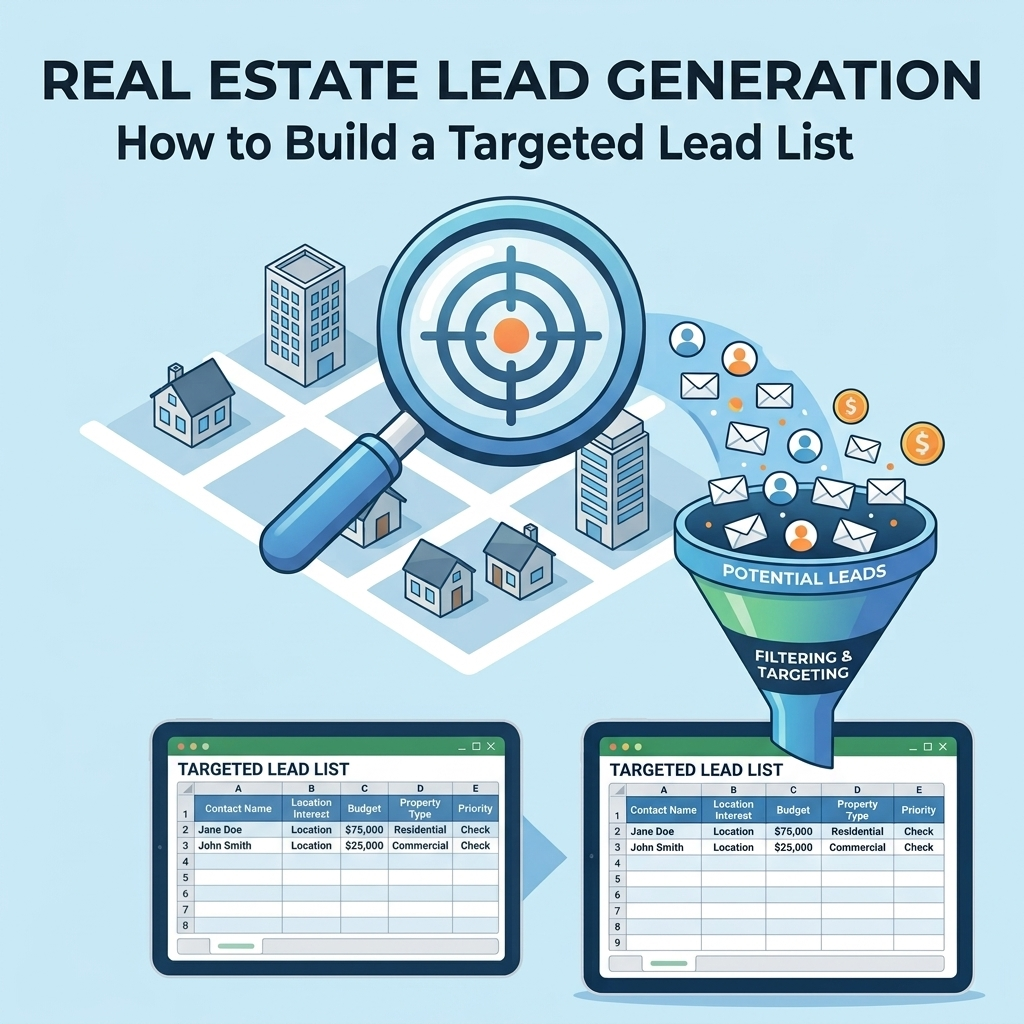
What Are Lead Generation Best Practices?
Lead generation best practices are practical methods for identifying, collecting, organizing, qualifying, and managing potential customers in a consistent way.
A well-structured lead generation process typically covers:
- Target audience definition
- Ideal customer profiling
- Prospect research
- Lead data collection
- Data quality management
- Lead segmentation
- Lead qualification
- Sales handoff
- Performance measurement
- Continuous process improvement
The goal is to make prospecting more focused and repeatable rather than relying on disconnected lists or inconsistent research methods.
1. Define Your Ideal Customer Before Generating Leads
The first step in effective lead generation is deciding who should actually be considered a potential customer.
Define the characteristics that make a prospect relevant to your business. Depending on the sales model, these may include:
- Industry
- Business type
- Geographic market
- Company characteristics
- Relevant business needs
- Decision-maker roles
- Existing customer characteristics
- Specific inclusion and exclusion criteria
A clear ideal customer profile helps prevent teams from spending time on prospects that were never appropriate targets.
2. Set Clear Lead Qualification Criteria
Lead generation and lead qualification are closely related, but they are not the same activity. Lead generation identifies potential prospects, while qualification determines whether those prospects fit the defined requirements.
Qualification criteria can consider:
| Qualification Area | Key Question |
|---|---|
| Company fit | Does the business match the target customer profile? |
| Industry fit | Is the business in a relevant industry or category? |
| Market fit | Is the company in the intended geographic or market segment? |
| Contact relevance | Is the identified contact relevant to the sales process? |
| Data completeness | Is enough information available for meaningful follow-up? |
Document these rules so different people can apply them consistently.
3. Prioritize Lead Quality Over Raw Lead Volume
A large prospect list may look impressive, but volume alone does not tell you whether the list supports your sales objectives.
Review lead quality using questions such as:
- Does the company match the intended market?
- Is the business information sufficiently complete?
- Is the contact relevant to the offering?
- Are duplicate records being removed?
- Are unsuitable businesses being excluded?
- Can the sales team actually use the resulting records?
When quality requirements are defined before data collection, teams can build prospect lists around business usefulness rather than database size.
4. Use Multiple Lead Generation Channels
Different markets respond to different prospecting approaches. Instead of depending on one source, businesses can evaluate several channels based on their target audience and sales process.
Potential channels include:
- Website inquiries
- Business directories
- Industry directories
- Professional networks
- Industry events
- Existing business relationships
- Referral activity
- Outbound prospect research
The objective is not to use every available channel. Select channels that provide access to the types of prospects the business actually wants to reach.
5. Build a Structured Lead Database
Lead information becomes more useful when it follows a consistent structure.
A basic B2B lead record may include:
- Company name
- Website
- Industry
- Business location
- Relevant contact or role
- Contact information
- Lead source
- Qualification status
- Sales segment
- Notes
Only include fields that support the sales process. An unnecessarily complex database can make data collection and maintenance harder.
6. Standardize Lead Data
Different sources often represent similar information in different ways. Standardization makes the resulting dataset easier to search, filter, compare, and maintain.
Standardization may include rules for:
- Company names
- Industry categories
- Locations
- Job roles
- Contact fields
- Lead statuses
- Source labels
For example, if one record identifies an industry as “Real Estate” and another uses a different label for the same category, the database should have a defined convention for handling those values.
7. Remove Duplicate and Irrelevant Records
Duplicate and irrelevant records can reduce the practical value of a lead database.
Before leads are passed to sales, review potential duplicates and records that fail the target criteria.
Useful matching indicators can include:
- Company name
- Website
- Business location
- Contact information
- Other business identifiers available within the database
When two records appear similar but their identity is uncertain, review them rather than automatically merging them.
8. Segment Leads for More Relevant Sales Activity
Segmentation allows sales teams to work with smaller, more meaningful groups of prospects.
Common segmentation criteria include:
- Industry
- Geographic territory
- Business type
- Company characteristics
- Decision-maker role
- Lead source
- Qualification status
- Sales stage
Segmentation should have a practical purpose. If a category does not change how the sales team researches, contacts, prioritizes, or manages prospects, it may not need to exist.
9. Create a Consistent Lead Handoff Process
A lead can lose value when it moves between marketing, research, and sales without clear ownership.
Define:
- When a lead is considered ready for sales.
- Which information must be available before handoff.
- Who receives the lead.
- How the lead status is recorded.
- How rejected or unqualified leads are handled.
A documented handoff process reduces ambiguity and makes it easier to identify where leads are being lost or delayed.
10. Automate Repetitive Lead Generation Tasks
Automation can be useful when the same lead-generation task is performed repeatedly according to clear rules.
Potential automation areas include:
- Data formatting
- Duplicate detection
- Filtering
- Lead segmentation
- Data validation checks
- Recurring reporting
- Workflow notifications
- Moving structured information between process stages
Start by documenting the process. Once the rules and exceptions are understood, determine which steps are suitable for automation.
11. Use Lead Scoring With Clear Rules
Lead scoring can help sales teams organize their attention when many prospects are being managed.
A scoring framework may consider:
| Factor | What It Measures |
|---|---|
| Profile fit | How closely the company matches the target profile |
| Business relevance | Whether the company's situation is relevant to the offering |
| Contact relevance | Whether the contact is appropriate for the sales process |
| Data completeness | Whether sufficient information is available for follow-up |
| Engagement | Whether the prospect has taken a meaningful action in the defined sales process |
Keep the scoring model understandable. Sales teams should be able to understand why a lead received its classification and how the criteria relate to their actual workflow.
12. Track Lead Generation Metrics
Lead generation should be measured beyond the number of records collected.
Depending on the business model, useful measures can include:
- Prospects identified
- Usable leads
- Qualified leads
- Sales opportunities
- Leads progressing through the sales process
- Customers generated from the process
- Revenue associated with qualified opportunities
Use metrics that match the company's sales process. A lead-generation report should help answer a business question, not simply display activity counts.
13. Create a Lead Generation Feedback Loop
One of the most useful lead generation best practices is to use sales feedback to improve future prospecting.
A practical feedback loop looks like this:
- Define the target.
- Generate prospects.
- Qualify the records.
- Send suitable leads to sales.
- Track the sales response.
- Identify which prospect characteristics correlate with useful opportunities.
- Adjust targeting and qualification rules.
- Repeat the process.
This turns lead generation into an iterative process instead of a one-time campaign.
14. Document Your Lead Generation Process
Documentation makes a lead-generation workflow easier to operate and improve.
Document at least:
- Ideal customer profile
- Target markets
- Required data fields
- Data sources
- Inclusion criteria
- Exclusion criteria
- Qualification rules
- Segmentation rules
- Lead handoff rules
- Performance metrics
Good documentation also helps determine which parts of the process should remain manual and which parts can be standardized or automated.
15. Review and Improve Lead Data Regularly
Lead generation is not complete when a list is created. Prospect databases require ongoing review because business information and sales requirements can change.
A maintenance process should define:
- Who owns the lead database
- How new records are added
- How duplicates are handled
- How data-quality issues are reported
- How records are segmented
- How sales feedback is incorporated
- How the process itself is reviewed
Lead Generation Best Practices Checklist
Use this checklist to review an existing lead-generation process:
- ☐ Define the ideal customer profile.
- ☐ Document target industries and markets.
- ☐ Define relevant decision-maker roles.
- ☐ Establish inclusion and exclusion criteria.
- ☐ Define required lead fields.
- ☐ Use appropriate and consistent data sources.
- ☐ Standardize lead records.
- ☐ Review duplicate records.
- ☐ Remove or classify unsuitable leads.
- ☐ Segment prospects for practical sales use.
- ☐ Establish clear qualification criteria.
- ☐ Define the sales handoff process.
- ☐ Automate repetitive tasks where appropriate.
- ☐ Track meaningful lead-generation metrics.
- ☐ Use sales feedback to improve future prospecting.
- ☐ Maintain the database and process over time.
Common Lead Generation Mistakes to Avoid
Focusing Only on Lead Volume
More records do not necessarily mean more useful sales opportunities. Define quality requirements alongside volume goals.
Starting Data Collection Before Defining the Target
Without a clear target profile, teams can spend substantial effort collecting businesses that do not fit the sales strategy.
Using Inconsistent Data Structures
Different naming conventions and field formats can make filtering, segmentation, and reporting harder.
Ignoring the Sales Team's Feedback
Sales teams interact with prospects directly and can provide useful information about which records are relevant and which qualification rules need adjustment.
Automating Before Documenting
Automation works best when the underlying process and decision rules are understood. Otherwise, automation can reproduce an unclear or inefficient workflow at greater scale.
How to Improve Lead Generation Step by Step
If your existing lead-generation process needs improvement, avoid changing everything at once. Start with the part of the process creating the greatest practical problem.
| Current Problem | First Area to Review |
|---|---|
| Too many irrelevant prospects | Target definition and qualification |
| Incomplete records | Required fields and data collection |
| Duplicate leads | Standardization and duplicate handling |
| Sales cannot prioritize leads | Segmentation and qualification |
| Too much manual work | Process documentation and automation |
| Lead performance is unclear | Measurement and reporting |
| Lead quality is declining | Feedback loop and database maintenance |
When to Get External Lead Generation Support
Some organizations can manage prospect research and lead generation internally. Others may need external support when the work becomes too repetitive, time-consuming, or difficult to scale with existing resources.
External support can be considered for activities such as:
- Prospect research
- Lead data collection
- Data organization
- Data processing
- Lead segmentation
- Structured lead-generation workflows
BrainyFlavors provides lead generation services for businesses that need support with structured prospecting and lead-data workflows.
Final Takeaway
The most useful lead generation best practices focus on process quality, not just lead volume. Start by defining the right prospects, establish clear qualification criteria, collect structured information, maintain data quality, segment leads, and create a consistent handoff to sales.
Then measure what happens after lead generation and use that feedback to improve targeting and qualification. When prospecting is treated as a repeatable business process, the organization has a stronger foundation for managing leads and improving sales activity over time.
Written by
Ashraful Haque
Process Improvement Consultant & Operations Specialist with expertise in Lean Six Sigma, financial workflows, and business intelligence systems.
Comments
Leave a comment
Comments are moderated and will appear after approval.
Recommended Products

Process Improvement Specialist and Artificial Intelligence: A Practical Self-Learning Course for Mapping Work, Finding Waste, Using AI Responsibly, and Building an Improvement Portfolio
A practical self-learning course for process improvement specialists covering work mapping, waste reduction, responsible AI use, and improvement portfolios.
Check Price
FYI: For Your Improvement - Competencies Development Guide, 6th Edition
A practical development companion for identifying professional strengths, building competencies, and turning improvement areas into focused growth.
Check Price![LLC Beginner's Guide [All-in-1]: Everything on How to Start, Run, and Grow Your First Company Without Prior Experience. Includes Essential Tax Hacks, Critical Legal Strategies, and Expert Insights](https://m.media-amazon.com/images/I/41o3X44QPLL._SS135_.jpg)
LLC Beginner's Guide [All-in-1]: Everything on How to Start, Run, and Grow Your First Company Without Prior Experience. Includes Essential Tax Hacks, Critical Legal Strategies, and Expert Insights
A beginner-friendly roadmap for starting, running, and growing an LLC, with practical guidance on business setup, taxes, and legal essentials.
Check PriceRelated Articles
Digital Marketing Tools & Software: Best Practices
Learn how to evaluate digital marketing tools and software by workflow, data, automation, reporting, and integration needs.
Read Article →Technical SEO Tools: Software and Best Practices
Compare technical SEO tools by purpose, learn what each can diagnose, and build a practical workflow for auditing and monitoring your website.
Read Article →Technical SEO Strategies: Advanced Best Practices
Learn how to diagnose technical SEO issues, improve crawling and indexing, manage canonical URLs, and build a practical optimization workflow.
Read Article →