B2B Lead Scoring: A Practical Framework for Better Leads
Build a practical B2B lead scoring framework to evaluate prospect fit, identify buying intent, and help sales teams prioritize the right opportunities.
B2B lead scoring helps businesses decide which prospects deserve attention first. Instead of treating every inquiry, email subscriber, or downloaded contact as equally valuable, teams assign scores based on how closely a prospect matches their ideal customer and how strongly their behavior indicates potential buying interest.
A practical scoring model can help sales and marketing teams focus on promising opportunities, reduce time spent on poorly matched contacts, and create a more consistent qualification process. The challenge is designing a model that reflects actual business priorities rather than rewarding every click or form submission.
This guide explains how B2B lead scoring works, how to build a simple scoring framework, and how to use scoring results to prioritize outreach and improve lead management.
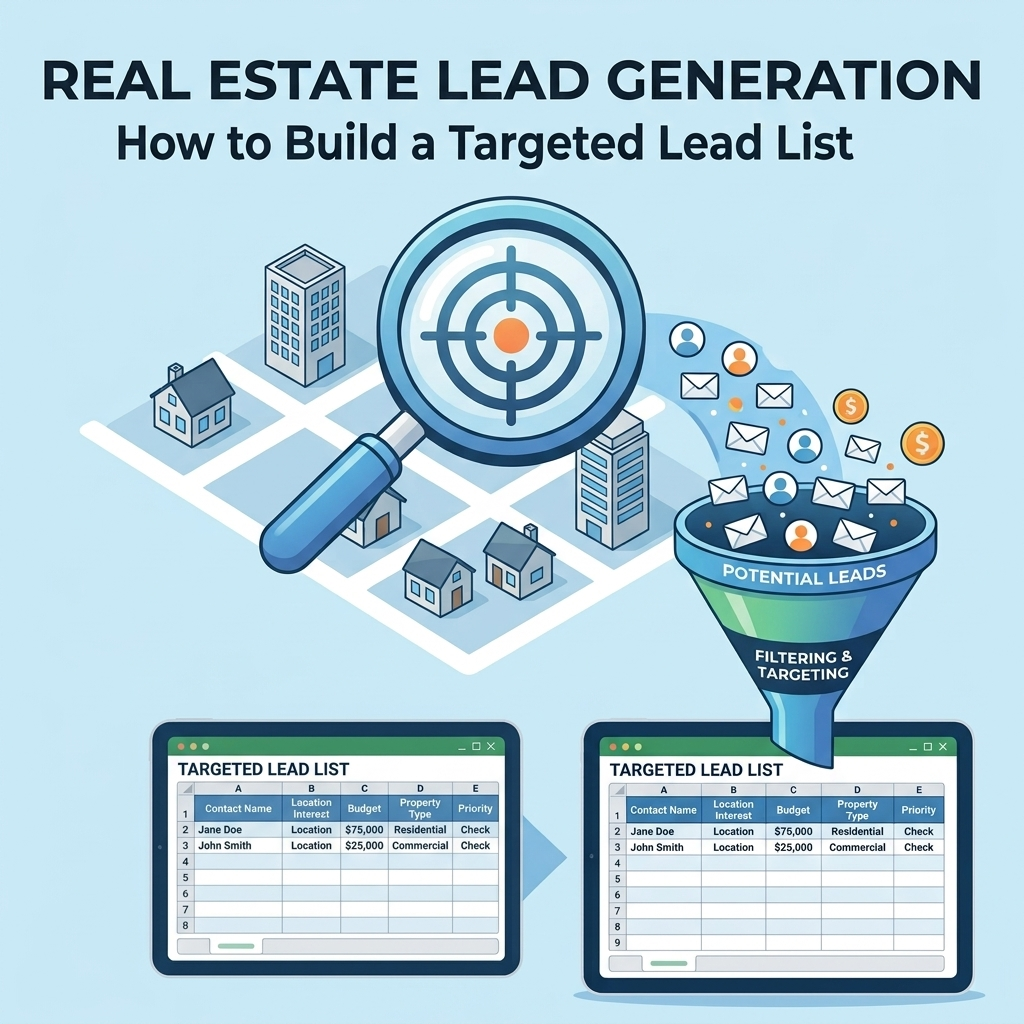
What Is B2B Lead Scoring?
B2B lead scoring is a method of assigning numerical values to potential business customers based on predefined qualification criteria. These criteria typically include company characteristics, the prospect's role, engagement with marketing content, and indicators of buying intent.
A lead with a high score may be a strong candidate for sales outreach, while a lower-scoring lead may need more information, additional engagement, or further qualification.
For example, a software consulting company might prioritize a prospect who manages operations at a target-sized business, visits its service pages, and requests a consultation over someone who downloads a general guide without demonstrating a clear business need.
Lead scoring does not establish that a prospect will purchase. It provides a structured way to compare prospects and decide what action to take next.
Why B2B Businesses Need a Lead Scoring Framework
Without a defined scoring process, lead prioritization often depends on individual judgment, recent activity, or whichever inquiry arrives most recently. This can make follow-up inconsistent and create disagreements between marketing and sales.
A practical B2B lead scoring framework addresses several common challenges:
- Inconsistent qualification: Different team members may apply different standards when deciding whether a lead is worth pursuing.
- Limited sales capacity: Sales representatives need a repeatable way to identify which prospects deserve immediate attention.
- Low-quality lead volume: A large contact database can contain businesses that do not fit the target market or have little purchase intent.
- Unclear marketing performance: Marketing teams need to distinguish between generating contacts and attracting prospects who become qualified opportunities.
- Delayed follow-up: Promising inquiries can receive insufficient attention when they are mixed with less relevant contacts.
Scoring provides a shared qualification language. Its value depends on whether the selected criteria reflect real customer quality and whether the team acts consistently on the results.
The Four Core Components of B2B Lead Scoring
A useful starting point is to divide scoring into four components: company fit, contact fit, engagement, and buying intent. Each component answers a different question about the prospect.
| Component | What it evaluates | Example signals | Primary question |
|---|---|---|---|
| Company fit | Whether the organization matches the target customer profile | Industry, company size, location, business model | Is this the type of company we serve? |
| Contact fit | Whether the individual is relevant to the buying process | Job title, department, responsibilities, decision-making role | Is this person relevant to the purchase? |
| Engagement | How the prospect interacts with the business | Email responses, webinar attendance, relevant page visits | Is this prospect actively engaging with us? |
| Buying intent | Whether behavior suggests an active business need | Consultation requests, quote inquiries, product demonstrations | Is this prospect considering a solution? |
These components should not automatically receive equal weight. A request for a relevant proposal may be more meaningful than several general content interactions. Similarly, a highly engaged contact from an unsuitable company may not represent a valuable opportunity.
How to Build a Practical B2B Lead Scoring Model
Step 1: Define your ideal customer profile
Before assigning points, establish which businesses are most likely to benefit from your product or service. This description is commonly called an ideal customer profile, or ICP.
Identify the characteristics that matter to your business, such as:
- Industry or business category
- Company size or operational complexity
- Geographic market served
- Business problem your service solves
- Available budget or purchasing capacity, when known and relevant
- Technology, workflow, or service requirements
Use existing customer experience and sales feedback to determine which characteristics deserve the most weight. Avoid selecting criteria simply because they are easy to collect.
Step 2: Identify the right contact characteristics
A suitable company does not necessarily mean every person at that company is a qualified lead. Identify the roles that typically influence, evaluate, approve, or use your solution.
For a B2B logistics service, relevant contacts might include logistics managers, supply chain directors, procurement managers, or business owners, depending on the offering and target company.
Assign points based on relevance to the buying process rather than assuming that a senior job title always indicates purchase authority.
Step 3: Choose meaningful engagement signals
Engagement scoring measures actions that indicate a prospect is interacting with your business. Possible signals include:
- Responding to a relevant sales email
- Attending a product or service webinar
- Visiting a service page
- Reviewing a case study or implementation guide
- Submitting a contact form
- Requesting a consultation or demonstration
Not all engagement deserves the same score. A single high-intent action can be more useful than several low-intent interactions. Assign points according to the action's relevance to your sales process.
Also consider the context. A page visit may be accidental, a shared device may create misleading activity, and repeated interactions may come from someone researching on behalf of another person.
Step 4: Separate buying intent from general engagement
Buying intent deserves special attention because it can indicate that a prospect is moving from general research toward evaluating a solution.
For example, compare these actions:
| Prospect action | Likely interpretation | Suggested treatment |
|---|---|---|
| Reads a general educational article | Early research or general interest | Assign a modest engagement score |
| Downloads a practical implementation guide | More focused research | Assign a moderate score if relevant |
| Visits a service page several times | Possible solution evaluation | Consider recency and other available signals |
| Requests a tailored quote | Direct commercial interest | Assign a strong intent score and review promptly |
These interpretations are starting points, not universal rules. Your own sales outcomes should determine how much each action contributes to the final score.
Step 5: Add negative scoring criteria
A scoring model that only adds points can overrate unsuitable prospects. Negative scoring helps account for information that reduces the likelihood of a good business fit.
Possible negative signals include:
- A company operates outside your service area.
- The organization belongs to an industry you do not serve.
- The contact uses an invalid or clearly nonbusiness email address, where that distinction is relevant to your qualification process.
- The prospect indicates that the project is outside the scope of your services.
- The contact is a vendor, job seeker, student, or competitor rather than a potential customer.
- The lead has opted out of marketing communications or otherwise cannot appropriately receive the planned outreach.
Distinguish between a weak fit and a contact preference. An unsubscribe, for example, should trigger the appropriate communication suppression process rather than merely lowering a score while outreach continues.
Step 6: Assign point values and establish thresholds
Start with a small scoring scale that your team can understand and maintain. The following model is illustrative, not a benchmark or a claim about typical B2B performance.
| Criterion | Illustrative points |
|---|---|
| Company matches the target industry | +15 |
| Company matches the target size | +10 |
| Contact has a relevant buying or influencing role | +15 |
| Visits a relevant service page | +5 |
| Attends a relevant webinar | +10 |
| Requests a consultation or quote | +25 |
| Company falls outside the target market | -20 |
| Contact is not a potential buyer or influencer | -15 |
In this example, a prospect who matches the target industry and company size, has a relevant role, visits a service page, and requests a quote receives 70 points before negative adjustments.
The arithmetic is straightforward:
Lead score = positive fit and activity points - negative adjustments
Use the total as a prioritization signal, not as a guarantee of qualification. The thresholds below are also illustrative and should be calibrated against your own results.
| Illustrative score | Suggested classification | Recommended next step |
|---|---|---|
| Below 20 | Low priority | Review fit and continue appropriate education |
| 20-44 | Developing | Gather missing information and monitor relevant engagement |
| 45-69 | High priority | Review qualification and consider sales outreach |
| 70 or above | Priority review | Check buying intent and route eligible leads promptly |
A prospect who requests a quote may deserve immediate review even if the overall score is below a threshold. Define exceptions for direct inquiries and other important signals so that a rigid score does not delay a legitimate sales opportunity.
Example: Comparing Two B2B Prospects
Consider a business that provides outsourced lead generation services to US companies. It wants to prioritize prospects based on customer fit and commercial interest.
| Scoring criterion | Prospect A | Prospect B |
|---|---|---|
| Target industry | +15 | +15 |
| Target company size | +10 | +10 |
| Relevant contact role | +15 | +15 |
| Service page visit | +5 | +5 |
| Quote request | +25 | 0 |
| Total score | 70 | 45 |
Both prospects appear to fit the target market, but Prospect A has also requested a quote. Under this illustrative model, Prospect A receives higher priority for prompt qualification and follow-up.
Prospect B should not automatically be discarded. The prospect may still have a genuine need but may not yet be ready to discuss a purchase. An appropriate next step could be to provide relevant information and monitor subsequent engagement.
The example illustrates why a scoring model should combine fit and intent instead of relying on activity alone.
How to Use Lead Scoring in Your Sales Workflow
A score becomes useful when it leads to a defined action. Before introducing a model, agree on how each score category affects qualification, follow-up, and ownership.
- Capture lead information: Collect the company and contact details needed to evaluate fit.
- Calculate the score: Apply the agreed rules to profile data and relevant prospect activities.
- Check qualification: Review missing information, negative signals, and any direct commercial inquiry.
- Assign the next action: Route suitable leads to sales, keep developing leads in an appropriate nurture process, and disqualify unsuitable contacts when justified.
- Record the outcome: Track whether sales accepted the lead, contacted the prospect, created an opportunity, or disqualified the record.
- Review the model: Compare scoring results with actual sales outcomes and adjust the criteria when necessary.
For a deeper look at the metrics that help evaluate lead quality and downstream performance, read B2B Lead Generation Metrics: Measure Lead Quality.
Lead Scoring and Lead Routing: How They Work Together
Lead scoring and lead routing solve different problems. Scoring estimates which prospects deserve attention, while routing determines who should receive each lead and what happens next.
| Process | Main purpose | Example |
|---|---|---|
| Lead scoring | Prioritize prospects | Identify a high-fit prospect with a recent quote request |
| Lead qualification | Confirm whether the prospect is a suitable opportunity | Check the business need, scope, and purchasing context |
| Lead routing | Assign the lead to the correct owner | Send a qualified prospect to the sales representative responsible for that market |
| Follow-up management | Ensure the assigned next step happens | Record contact attempts and the next planned action |
A high score should not automatically override account ownership, territory rules, service eligibility, or communication preferences. Build the routing process around the business rules that govern your sales team.
See Lead Routing and Assignment: Build a Reliable Sales Handoff for more on creating a consistent handoff process.
Choosing a Lead Scoring Approach
The right approach depends on your data quality, lead volume, sales process, and available resources. A complicated model is not necessarily better than a transparent one.
| Approach | How it works | Best suited for | Key limitation |
|---|---|---|---|
| Manual scoring | Team members evaluate leads using a defined checklist | Small teams with manageable lead volumes | Can become inconsistent or time-consuming as volume grows |
| Rule-based scoring | Predefined conditions assign points to each lead | Teams that want repeatable, explainable qualification | Requires maintenance when buyer behavior changes |
| Predictive scoring | A statistical or machine-learning model estimates the likelihood of a defined outcome using historical data | Businesses with suitable historical records and analytical capacity | Depends on data quality, outcome definitions, and ongoing validation |
For many businesses establishing their first scoring process, rule-based scoring is a practical starting point. It makes assumptions visible and allows the team to learn which signals actually correspond to qualified opportunities.
Predictive scoring may be worth considering when the business has sufficient reliable historical data and a clearly defined outcome to predict. It should not be adopted merely because it sounds more advanced.
How to Measure Whether Your Lead Scoring Model Works
Do not evaluate a scoring model solely by the number of leads that cross a threshold. The important question is whether prioritization helps the business identify and progress suitable prospects.
Track a small set of measures that connect scoring decisions to sales outcomes:
- Sales acceptance rate: The proportion of routed leads that sales accepts for follow-up or qualification, using a consistent definition.
- Lead-to-opportunity conversion: The proportion of leads that progress to a defined sales opportunity.
- Lead-to-customer conversion: The proportion of leads that eventually become customers, where the sales cycle and data allow meaningful measurement.
- Time to first follow-up: The elapsed time between the relevant lead trigger and the first recorded sales contact.
- Disqualification rate: The proportion of reviewed leads that sales determines are unsuitable, with reasons recorded.
- Score-band performance: The observed outcomes of leads in different score categories.
Compare these measures across score bands and over consistent periods. If high-scoring leads are frequently rejected, investigate whether the model overvalues certain activities, underweights negative signals, or relies on inaccurate company data.
Interpret results in context. A longer sales cycle, changes in lead sources, and differences between market segments can affect the apparent performance of a scoring model.
For a broader framework covering lead quality and conversion measurement, use the guide to B2B lead generation metrics alongside your scoring analysis.
Common B2B Lead Scoring Mistakes
Rewarding every engagement equally
An email open, an educational page visit, and a direct request for a proposal do not necessarily represent the same level of interest. Assign points according to the relevance of each action, and avoid allowing repeated low-value activity to overwhelm stronger qualification signals.
Ignoring company fit
A prospect can be highly engaged but unsuitable for your offering. Include company and contact criteria so that activity is evaluated in the context of a potential customer relationship.
Using arbitrary thresholds indefinitely
Initial point values are hypotheses. Review whether each score category corresponds to meaningful sales outcomes, and change the model when evidence suggests the rules are not working.
Allowing outdated engagement to dominate
A prospect who was active months ago may no longer be evaluating a purchase. Where appropriate, use recency rules or score decay to reduce the influence of old engagement. Apply these rules carefully so that a meaningful long-term relationship is not mistakenly treated as irrelevant.
Failing to define what happens after scoring
If sales and marketing do not agree on ownership, qualification standards, and follow-up expectations, the score may not improve the actual workflow. Connect each score category to an action and a responsible owner.
Collecting more personal data than necessary
Use relevant business information and behavioral signals for a defined purpose. Limit access appropriately, respect communication preferences, and review applicable privacy and marketing requirements for the markets you serve.
Using Google Sheets to Start a Lead Scoring Process
A spreadsheet can be sufficient for an initial scoring model when lead volume is manageable and the team can maintain consistent records. It also makes the scoring rules easy to inspect before investing in a more complex setup.
A practical spreadsheet may include the following fields:
- Lead ID or another stable record identifier
- Company name and industry
- Company size or target segment
- Contact role
- Engagement and buying-intent signals
- Negative scoring adjustments
- Total score
- Score category
- Assigned owner
- Qualification status and disqualification reason
- Last activity date and next action
Keep the scoring rules in a separate reference table so that the team can update point values without changing the logic manually for every lead. Use validation rules for categories, consistent definitions for activities, and duplicate checks to reduce data-quality problems.
When lead volume increases, the process spans multiple data sources, or manual updates become unreliable, consider automating score calculations and reporting. BrainyFlavors offers Google Sheets Automation for businesses that need more structured spreadsheet workflows.
When to Review and Improve Your Scoring Model
Lead scoring is not a one-time configuration. Review the model when your target market changes, your service offering evolves, lead sources shift, or sales outcomes reveal a mismatch between scores and actual lead quality.
Use a structured review process:
- Check whether the ideal customer profile still reflects your most suitable customers.
- Review which signals are associated with sales acceptance and opportunity creation.
- Identify score categories with unexpectedly high disqualification rates.
- Check for missing data, duplicate records, and inconsistent activity tracking.
- Adjust a limited number of rules at a time so that the effect can be evaluated.
- Document each change and compare subsequent results using consistent definitions.
When evaluating changes, remember that correlation does not prove that a particular activity causes a sale. The purpose of the review is to improve prioritization based on observed outcomes, not to assume that every high-scoring behavior directly produces revenue.
Build a More Reliable Lead Generation Process
B2B lead scoring works best as one part of a complete lead generation system. The process begins with a clear target customer, uses relevant qualification signals to prioritize prospects, and connects those decisions to timely follow-up and measurable sales outcomes.
If your business needs help developing a more structured prospect pipeline, improving lead qualification, or organizing business contact data, explore BrainyFlavors Lead Generation services.
Conclusion
A practical B2B lead scoring model combines company fit, contact relevance, engagement, and buying intent into a consistent prioritization framework. Negative signals help prevent unsuitable prospects from receiving inflated scores, while clear thresholds connect scoring results to specific next steps.
Start with a transparent rule-based model, document the assumptions behind your point values, and compare score categories with real sales outcomes. As your data and process improve, refine the model to help your team focus on the prospects most likely to become suitable business opportunities.
For the broader process behind identifying, attracting, and qualifying potential customers, continue with Lead Generation Fundamentals: A Practical Guide.
Written by
Ashraful Haque
Process Improvement Consultant & Operations Specialist with expertise in Lean Six Sigma, financial workflows, and business intelligence systems.
Comments
Leave a comment
Comments are moderated and will appear after approval.
Recommended Products

Process Improvement Specialist and Artificial Intelligence: A Practical Self-Learning Course for Mapping Work, Finding Waste, Using AI Responsibly, and Building an Improvement Portfolio
A practical self-learning course for process improvement specialists covering work mapping, waste reduction, responsible AI use, and improvement portfolios.
Check Price
202 Cashflow Game - Rich Dad Poor Dad Robert Kiyosaki Game Robert Kiyosaki Cashflow Board Game + Free Expredited Shipping
A financial strategy board game built around cash-flow concepts, offering an interactive way to explore money decisions, income, expenses, and investing.
Check Price
Amazon Basics Mesh Pen Holder and Desktop Desk Organizer, Office Caddy Storage for Writing Utensils, 9.1 x 5.9 x 5.5 inches, Black
A simple mesh desk caddy that keeps pens, pencils, markers, and small office essentials organized and easy to reach.
Check PriceRelated Articles
B2B Lead Generation Metrics: Measure Lead Quality
Discover the B2B lead generation metrics that reveal lead quality, sales pipeline performance, and revenue impact beyond total lead volume.
Read Article →Lead Routing and Assignment: Build a Reliable Sales Handoff
Build a reliable lead routing and assignment process that connects each prospect with the right sales representative and keeps follow-up accountable.
Read Article →Record to Report Solutions for Growing Businesses
Discover how growing businesses can build reliable record-to-report processes, improve financial visibility, and prepare their accounting operations to scale.
Read Article →