Advanced Lead Generation Strategies and Best Practices
Explore advanced lead generation strategies for finding better prospects, improving lead quality, and building a more reliable B2B sales pipeline.

Generating more leads is not always the same as generating better leads. For B2B companies, an effective lead generation strategy should help the sales team identify relevant prospects, organize useful prospect data, prioritize opportunities, and create a repeatable path from prospecting to conversion.
Basic tactics such as contact forms, social media posts, and broad prospect lists can support growth, but companies operating in competitive markets often need a more structured approach. Advanced lead generation strategies combine precise targeting, better data, segmentation, automation, qualification, and continuous measurement.
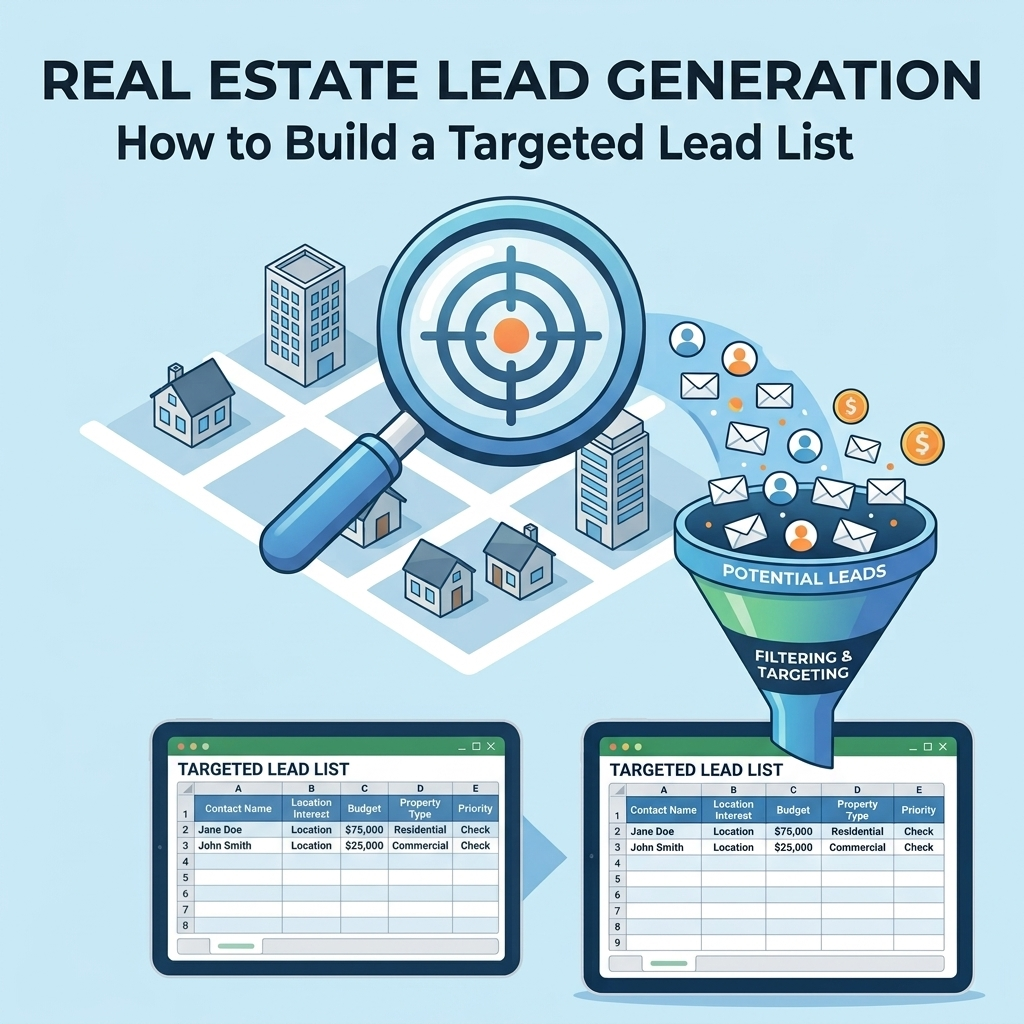
What Are Advanced Lead Generation Strategies?
Advanced lead generation strategies are structured methods for finding, evaluating, organizing, and engaging potential customers with greater precision than broad prospecting alone.
Instead of treating every contact as an equal opportunity, an advanced process considers factors such as:
- Industry and business type
- Company size and operating characteristics
- Geographic market
- Business role or decision-maker position
- Potential fit with the company's products or services
- Available business and contact information
- Lead source and acquisition channel
- Engagement or buying signals
- Sales qualification criteria
The objective is not simply to produce a larger contact list. The objective is to create a prospecting system that gives sales and marketing teams more useful opportunities to work with.
Why Lead Generation Needs a More Structured Approach
A lead database can contain thousands of contacts while still producing limited sales value if the records are poorly targeted, incomplete, duplicated, outdated, or disconnected from the company's ideal customer profile.
A more mature lead generation process connects several activities:
- Target definition: Determine which businesses and roles are relevant.
- Prospect discovery: Identify companies and contacts that fit the target.
- Data collection: Gather the information required for sales outreach.
- Data validation: Review records for completeness and consistency.
- Segmentation: Organize prospects into meaningful groups.
- Qualification: Separate potentially relevant prospects from poor-fit records.
- Distribution: Make usable lead data available to the appropriate sales or marketing workflow.
- Measurement: Monitor the quality and business outcomes of the process.
1. Build a Precise Ideal Customer Profile
One of the most important advanced lead generation strategies is to define exactly what a qualified prospect looks like before collecting large volumes of data.
An ideal customer profile can include:
| Criteria | Example Consideration |
|---|---|
| Industry | Which industries have a relevant business need? |
| Location | Which cities, states, regions, or markets are being targeted? |
| Company profile | What types of organizations are appropriate prospects? |
| Decision maker | Which roles are involved in the purchase decision? |
| Business need | What problem or operational requirement makes the prospect relevant? |
| Exclusions | Which companies, industries, locations, or roles should be removed? |
This approach helps prevent a common problem in lead generation: collecting data first and deciding whether the contacts are useful afterward.
2. Segment Leads Before Outreach
Not every prospect should receive the same message. Segmentation allows teams to organize leads according to characteristics that matter to the sales process.
Useful segmentation dimensions may include:
- Industry
- Geographic market
- Business type
- Job role
- Company characteristics
- Product or service relevance
- Lead source
- Stage in the sales process
For example, a company selling accounting services could separate prospects by business type and then create different outreach messages for each segment. This can make the prospecting process more relevant than sending identical messaging to an unsegmented list.
3. Use Data Enrichment to Improve Prospect Records
Basic contact information is often insufficient for effective B2B prospecting. Data enrichment adds useful business context to a prospect record so sales teams can better understand who they are contacting.
Depending on the business requirement, a lead record may include information such as:
- Business name
- Website
- Business location
- Industry classification
- Relevant business role
- Professional contact information
- Company characteristics
- Source or acquisition information
The important principle is to collect information that supports a real business decision. More fields do not automatically mean better leads.
4. Combine Lead Generation With Lead Qualification
Lead generation and lead qualification solve different problems.
Lead generation focuses on finding potential prospects. Lead qualification determines whether those prospects are relevant enough to receive additional sales attention.
A practical qualification framework can evaluate:
- Whether the prospect matches the ideal customer profile
- Whether the company appears relevant to the offering
- Whether the contact has an appropriate role
- Whether sufficient information is available for outreach
- Whether the prospect belongs in the intended geographic or market segment
This creates a more useful handoff between marketing, prospecting, and sales.
5. Create Multiple Prospecting Data Sources
Relying on one source can make a lead generation system less flexible. A broader strategy can combine different discovery methods according to the target market and available resources.
Potential sources include:
- Company websites
- Public business directories
- Professional networks
- Industry directories
- Trade and professional associations
- Existing customer and prospect records
- Inbound website inquiries
- Event and conference information
Each source should be evaluated according to relevance, data quality, accessibility, and how well it supports the company's target audience.
6. Automate Repetitive Lead Generation Tasks
Automation can reduce repetitive manual work in lead generation, particularly when teams regularly process large amounts of prospect information.
Potential automation areas include:
- Collecting structured prospect information
- Standardizing business names and fields
- Identifying duplicate records
- Applying predefined inclusion and exclusion criteria
- Segmenting records
- Moving qualified records into downstream workflows
- Generating recurring lead reports
- Tracking lead-generation activity
Automation should support a clearly defined process rather than simply automate an inefficient one. Before automating a task, document the desired input, decision rules, output, and exception cases.
7. Build a Repeatable Lead Data Workflow
A scalable lead generation operation benefits from a consistent workflow rather than one-off list building.
A practical workflow can look like this:
- Define: Establish the target audience and qualification criteria.
- Discover: Find businesses and contacts that match the target.
- Collect: Gather relevant prospect information.
- Clean: Standardize and remove obvious data-quality issues.
- Filter: Apply inclusion and exclusion rules.
- Segment: Group leads according to sales requirements.
- Qualify: Identify prospects that meet the defined criteria.
- Deliver: Provide the resulting lead data in a format the team can use.
- Measure: Review downstream performance and improve the process.
This workflow can be implemented manually for smaller operations and progressively automated as volume and complexity increase.
8. Use Lead Scoring Carefully
Lead scoring can help sales teams prioritize records, but a score is only useful when its criteria reflect the actual sales process.
A simple scoring framework might consider:
| Factor | Question |
|---|---|
| Profile fit | Does the prospect match the target customer profile? |
| Business relevance | Does the company have a relevant need? |
| Contact relevance | Is the identified contact appropriate for the offering? |
| Data quality | Is enough information available for useful outreach? |
| Engagement | Has the prospect taken an action that matters to the sales process? |
The scoring model should be reviewed periodically. If sales teams consistently reject highly scored records, the qualification logic may need to be changed.
9. Separate Lead Volume From Lead Quality
Lead volume is easy to measure, but it should not be the only measure used to evaluate a lead generation process.
A more useful measurement framework can examine several stages:
- Number of prospects identified
- Number of usable records
- Number of qualified leads
- Number of sales opportunities created
- Lead-to-opportunity movement
- Opportunity-to-customer movement
- Revenue associated with the sales process
The appropriate metrics depend on the company's sales cycle and business model. The key principle is to connect lead-generation activity to downstream business outcomes rather than evaluating lists only by their size.
10. Create Lead Generation Feedback Loops
Advanced lead generation should improve over time. Sales feedback can reveal which segments, roles, industries, or prospect characteristics are producing useful opportunities.
A basic feedback loop is:
- Generate prospects.
- Qualify and distribute them.
- Track sales outcomes.
- Identify patterns in accepted and rejected leads.
- Update targeting criteria.
- Improve data collection and segmentation.
- Repeat the process.
This turns lead generation from a one-time list-building exercise into an ongoing business process.
11. Use Lead Generation Technology Where It Adds Value
Technology can support different parts of the lead generation workflow, but the right solution depends on the organization's process, volume, budget, and data requirements.
Common technology categories include:
| Technology Area | Primary Purpose |
|---|---|
| CRM | Manage prospect and customer relationships |
| Lead database | Store and organize prospect information |
| Automation tools | Reduce repetitive process steps |
| Spreadsheets and databases | Manage structured lead information |
| Reporting tools | Monitor lead-generation activity and outcomes |
The technology should follow the process. Purchasing or connecting more tools does not solve unclear targeting, poor data definitions, or weak qualification criteria.
12. Improve Lead Generation With Process Documentation
Documenting the lead-generation workflow makes it easier to train team members, identify bottlenecks, automate repetitive steps, and maintain consistent output.
At minimum, document:
- Target customer definition
- Required lead fields
- Data sources
- Inclusion criteria
- Exclusion criteria
- Qualification rules
- Segmentation rules
- Data-quality checks
- Lead handoff process
- Performance metrics
A documented process also makes it easier to identify which steps should remain manual and which steps are suitable for automation.
Advanced Lead Generation Checklist
Use this checklist when reviewing an existing lead generation operation:
- ☐ Is the ideal customer profile clearly defined?
- ☐ Are target industries and markets documented?
- ☐ Are relevant decision-maker roles defined?
- ☐ Are exclusion criteria documented?
- ☐ Are lead records standardized?
- ☐ Are duplicate records identified?
- ☐ Is lead data segmented?
- ☐ Are qualification rules consistent?
- ☐ Are repetitive tasks automated where appropriate?
- ☐ Can sales teams easily use the resulting lead data?
- ☐ Are lead-generation results connected to downstream sales metrics?
- ☐ Is there a regular feedback loop for improving targeting?
How to Choose the Right Lead Generation Approach
The right approach depends on the problem your business is trying to solve.
| Primary Problem | Useful Focus |
|---|---|
| Too few prospects | Expand relevant discovery sources and targeting coverage |
| Too many irrelevant leads | Improve the ideal customer profile and qualification rules |
| Incomplete lead records | Improve data collection and enrichment |
| Duplicate or inconsistent data | Introduce standardization and data-quality controls |
| Too much manual work | Document and automate repetitive workflow steps |
| Sales cannot prioritize leads | Improve segmentation and qualification |
| Lead generation results are unclear | Connect lead metrics with downstream sales outcomes |
When to Outsource Lead Generation
Building an internal lead-generation operation can require time for research, data organization, process design, quality control, and ongoing maintenance. Outsourcing may be considered when an organization needs prospect data at a scale that is difficult to support with its existing team or wants external support for a defined part of the workflow.
Before outsourcing, define the required audience, fields, exclusions, output format, qualification criteria, and quality expectations. A clearly documented brief makes it easier to evaluate whether an external lead-generation service is producing useful output.
BrainyFlavors provides lead generation services for businesses that need structured prospecting support and organized lead data.
Final Takeaway
Advanced lead generation is less about collecting the largest possible number of contacts and more about building a repeatable system for identifying relevant prospects.
The strongest process starts with a clear ideal customer profile, uses targeted data collection, improves records through organization and validation, applies meaningful segmentation and qualification, automates repetitive work where appropriate, and measures results beyond simple lead volume.
When these elements work together, lead generation becomes a structured business process that can be reviewed, improved, and scaled as the company's sales requirements change.
Written by
Ashraful Haque
Process Improvement Consultant & Operations Specialist with expertise in Lean Six Sigma, financial workflows, and business intelligence systems.
Comments
Leave a comment
Comments are moderated and will appear after approval.
Recommended Products
![LLC Beginner's Guide [All-in-1]: Everything on How to Start, Run, and Grow Your First Company Without Prior Experience. Includes Essential Tax Hacks, Critical Legal Strategies, and Expert Insights](https://m.media-amazon.com/images/I/41o3X44QPLL._SS135_.jpg)
LLC Beginner's Guide [All-in-1]: Everything on How to Start, Run, and Grow Your First Company Without Prior Experience. Includes Essential Tax Hacks, Critical Legal Strategies, and Expert Insights
A beginner-friendly roadmap for starting, running, and growing an LLC, with practical guidance on business setup, taxes, and legal essentials.
Check Price
202 Cashflow Game - Rich Dad Poor Dad Robert Kiyosaki Game Robert Kiyosaki Cashflow Board Game + Free Expredited Shipping
A financial strategy board game built around cash-flow concepts, offering an interactive way to explore money decisions, income, expenses, and investing.
Check Price
Amazon Basics Mesh Pen Holder and Desktop Desk Organizer, Office Caddy Storage for Writing Utensils, 9.1 x 5.9 x 5.5 inches, Black
A simple mesh desk caddy that keeps pens, pencils, markers, and small office essentials organized and easy to reach.
Check PriceRelated Articles
Digital Marketing Tools & Software: Best Practices
Learn how to evaluate digital marketing tools and software by workflow, data, automation, reporting, and integration needs.
Read Article →Technical SEO Tools: Software and Best Practices
Compare technical SEO tools by purpose, learn what each can diagnose, and build a practical workflow for auditing and monitoring your website.
Read Article →Technical SEO Strategies: Advanced Best Practices
Learn how to diagnose technical SEO issues, improve crawling and indexing, manage canonical URLs, and build a practical optimization workflow.
Read Article →